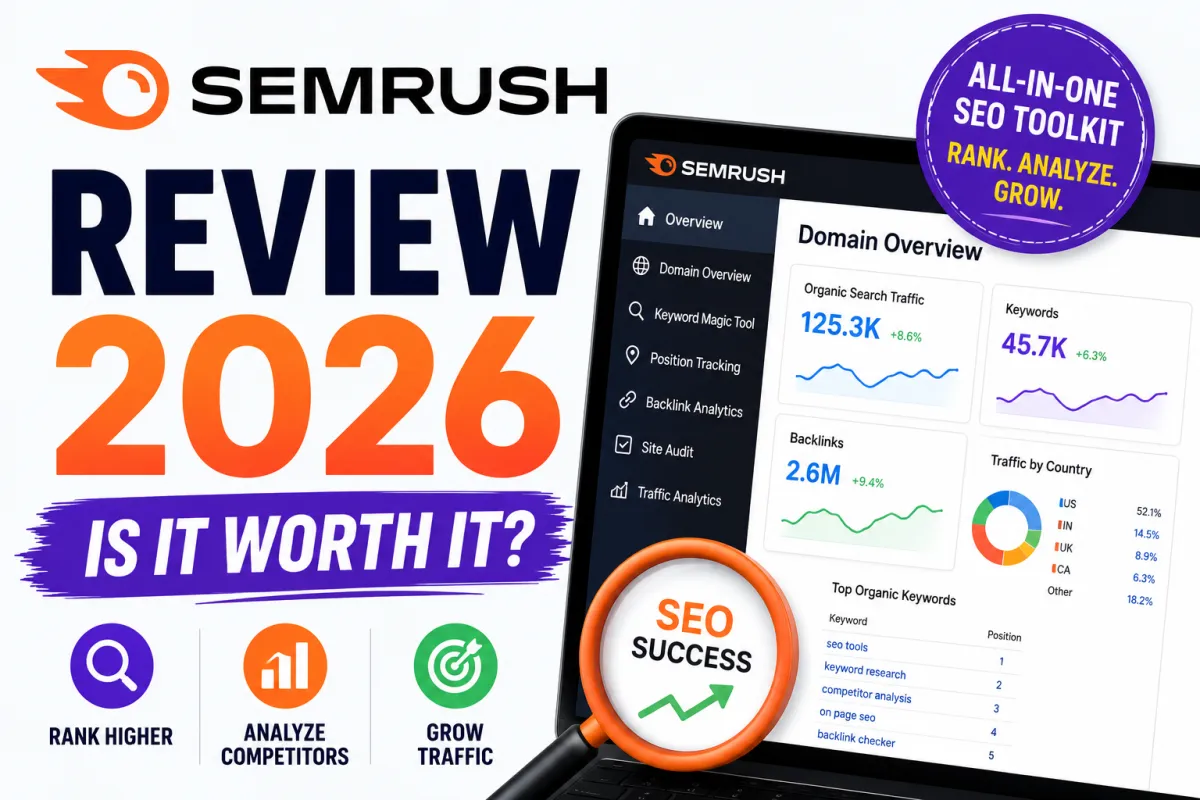
Semrush Review 2026: is $140/Month Worth It for a Small Business Owner Trying to Rank on Google?
Semrush is the most comprehensive SEO and digital marketing platform available for small businesses — and at $139.95/month for the entry-level Pro plan, it's also one of the most significant tool investments you'll make. Is it worth it? The honest answer depends on what you're trying to accomplish and how serious you are about organic search as a traffic channel.
Here's the complete picture.
What Is Semrush?
Semrush is an all-in-one digital marketing platform covering SEO, content marketing, competitor research, PPC advertising, social media management, and local SEO. Its core strength is data: Semrush has one of the largest keyword databases in the industry (over 25 billion keywords) and provides detailed competitive intelligence that lets you see exactly what any website is ranking for, where their traffic comes from, and what their backlink profile looks like.
In 2026, Semrush has deepened its AI integration across most features — AI-powered content briefs, writing assistance, competitive gap analysis, and SERP feature tracking for Google's AI-generated results.
Semrush Pricing in 2026
Pro — $139.95/month (monthly) or approximately $117/month (annual billing). Up to 5 projects, 500 keyword tracking, and access to core SEO, content, and research tools.
Guru — $249.95/month (monthly). Adds historical data, content marketing platform, extended limits.
Business — $499.95/month (monthly). For agencies and large teams.
Free — Limited searches per day. Useful for testing but not for regular use.
Semrush also offers a 7-day free trial on paid plans. It's worth using this trial seriously — running your actual website through a site audit, researching your target keywords, and analyzing your top competitors — to evaluate real value before committing.
What Semrush Does Really Well
Keyword research is the industry gold standard. Semrush's keyword database is unmatched in size and accuracy for most markets. When you search a keyword, you see monthly search volume, keyword difficulty, competitive density, SERP features, related questions, and long-tail variations — all in one view. For building an SEO content strategy from scratch, this data is the foundation.
Competitor analysis is genuinely revelatory. Enter any competitor's domain and Semrush shows you every keyword they rank for, their estimated monthly traffic, their top-performing pages, their backlink sources, and their paid advertising strategy. For a solopreneur trying to understand why a competitor shows up everywhere in Google searches, this intelligence is invaluable.
The Site Audit tool is thorough and actionable. Semrush crawls your website and produces a prioritized list of technical SEO issues — broken links, slow pages, missing meta descriptions, duplicate content, crawlability problems. Each issue includes an explanation and instructions for fixing it. For solopreneurs without technical SEO backgrounds, this guidance replaces hours of research.
Keyword position tracking is accurate and reliable. Once you set up a project, Semrush tracks your rankings for target keywords daily, shows movement over time, and compares your position to competitors. Seeing your rankings improve as you publish optimized content is one of the most motivating feedback loops in content marketing.
The AI content brief generator saves significant time. Semrush's Content Marketing Platform generates detailed content briefs for target keywords — recommended word count, topics to cover, questions to answer, semantically related terms to include. This turns "write about topic X" into a structured writing guide that dramatically improves the quality of AI-assisted content.
Where Semrush Falls Short
The price is a real barrier for early-stage solopreneurs. At $140/month, Semrush is a meaningful investment that's hard to justify when your website is brand new, has minimal content, and has yet to earn any organic traffic. The data Semrush provides is most valuable when you have enough content and history to act on it meaningfully.
The feature breadth can be overwhelming. Semrush does so much — SEO, PPC, social media, content, local search — that new users often don't know where to start. The platform rewards users who invest time in learning it, but the learning curve is steeper than simpler tools like Ubersuggest.
Some features overlap with free tools. Google Search Console and Google Analytics provide keyword and traffic data for free. Semrush's data is more comprehensive and actionable, but solopreneurs who need only basic keyword tracking can get meaningful results from free tools before graduating to Semrush.
Who Should Subscribe to Semrush?
Semrush is worth the investment for solopreneurs and small business owners who are serious about organic search as a long-term traffic and revenue strategy — and who are actively creating content to build that traffic. If you're publishing one to two optimized blog posts or pages per week and tracking their performance, Semrush pays for itself in the organic traffic it helps you earn.
If you're still building your first ten pages of content and don't yet have a consistent publishing cadence, start with Ubersuggest ($29/month) or even Google's free tools, and graduate to Semrush when you're ready to go deeper.
The Verdict
Semrush earns a 4.5/5 for committed content marketers and SEO-focused small businesses. The keyword research, competitor intelligence, and site audit tools are genuinely best-in-class. For businesses where organic search is a primary customer acquisition channel, the ROI from ranking for even a handful of valuable keywords can exceed the tool's annual cost many times over.
For early-stage solopreneurs not yet ready to invest $140/month: use the 7-day free trial to explore competitor research on your niche, download what you learn, then revisit the subscription when your content strategy is up and running.